










In a music tech landscape increasingly defined by complex interfaces and near-limitless sound design options, a new hardware concept is taking a very different approach, stripping synthesis back to a single interaction point.
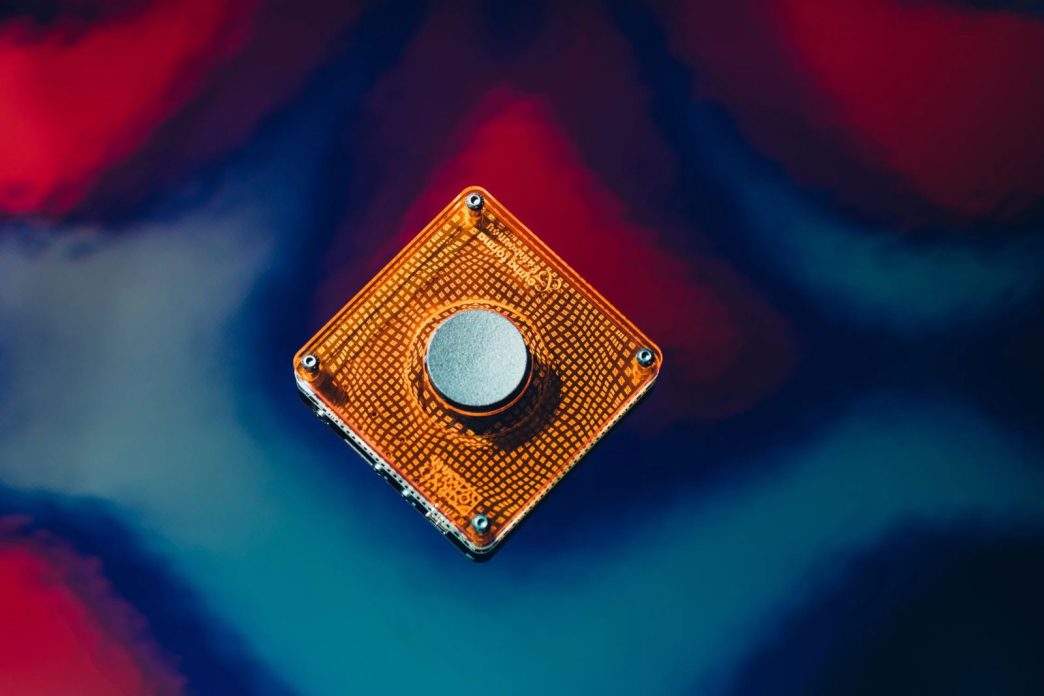
The RND synth by Cyma Forma is built around one central control: a single button capable of generating more than four billion possible sound variations. Developed in collaboration with French producer Bambounou and audio designer Nick Donaldson, the device prioritises unpredictability over precision, turning each press into a completely new and non-repeatable musical outcome.
Rather than functioning as a traditional instrument in the conventional sense, RND behaves more like a generative system. Each activation produces four layered voices at once, with independently created rhythms, scales and sequencing structures emerging instantly from the engine. 
Under the hood, the synth combines eight different synthesis methods, including FM, additive, acid-style tones, supersaw textures, noise generation and Karplus–Strong modelling, all blended into a single output system designed to avoid predictable repetition.
Instead of encouraging detailed sculpting, the concept deliberately moves away from the usual producer workflow. Each interaction removes control rather than adding it, replacing incremental tweaking with immediacy, unpredictability and rapid experimentation.
At Superbooth 2026 in Berlin, the device stood apart from many of the conventionally complex synth unveilings surrounding it, drawing attention for its stripped-back philosophy in a space often dominated by feature-heavy flagship instruments.
The idea also reflects a wider sentiment among producers working within increasingly overloaded software environments, where creative flow is often interrupted by excessive choice, layered menus and expanding toolsets.
RND shifts that dynamic entirely. Rather than refining sound step-by-step, it reframes the act of creation as a moment of discovery, where each press becomes a complete musical idea rather than a building block.
Despite its minimal interface, the unit still offers practical integration for studio use, including USB-C audio, MIDI connectivity, analogue sync and multitrack output support, allowing it to sit within larger production setups rather than existing purely as an experimental standalone device.
The RND synth is currently available for pre-order, with shipping expected later this year.